The Complete Peptide Guide
Every peptide worth knowing about, from FDA-approved GLP-1s to emerging longevity compounds. Organized by what they do, with honest evidence ratings.
Peptide Reconstitution Calculator
Pick a vial, your water volume, your dose. Get the exact insulin syringe units to draw.
GLP-1 Cost Calculator
Compare monthly costs for compounded and branded GLP-1 across our vetted cohort.
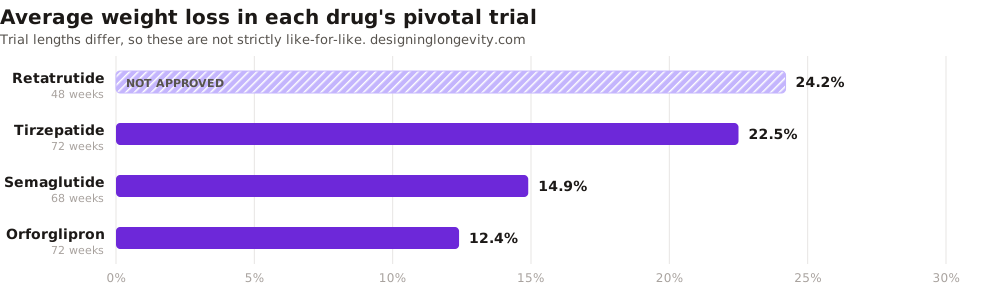
Average weight loss in each drug's pivotal trial
Mean percentage of body weight lost. Trial lengths differ, so these are not strictly like-for-like, and the duration is shown on every bar.
Show the underlying numbers
| Drug | Weight loss | Duration | Dose | Trial | Available? |
|---|---|---|---|---|---|
| Retatrutide | 24.2% | 48 weeks | 12mg weekly | Phase 2 | No |
| Tirzepatide | 22.5% | 72 weeks | 15mg weekly | SURMOUNT-1 | Yes, by prescription |
| Semaglutide | 14.9% | 68 weeks | 2.4mg weekly | STEP 1 | Yes, by prescription |
| Foundayo (orforglipron) | 11.1% | 72 weeks | 17.2mg daily | FDA label, Trial 1 | Yes, by prescription |
Which peptides actually have evidence?
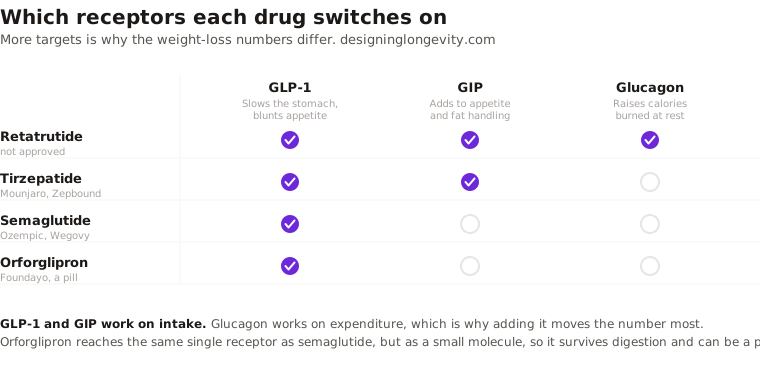
Every graded claim across every peptide, in one table, grouped by what you are trying to achieve and sorted by how strong the evidence really is.
Semaglutide
The Ozempic molecule, gold standard for weight loss
FDA-approved (Ozempic, Wegovy)
Retatrutide
First-in-class triple agonist, up to 28.7% weight loss in trials
Phase 3 complete. Lilly plans US filing in Q1 2027.
Orforglipron
Daily small-molecule GLP-1 pill, with or without food
FDA-approved April 2026 as Foundayo tablets for labeled adult weight reduction.
AOD-9604
GH fragment sold for fat loss, but it failed its big trial
Not FDA-approved. Failed its phase 2b obesity trial.
5-Amino-1MQ
NAD+ and fat-loss claims, all of them from mouse studies
Not a peptide. No completed human trials.
CJC-1295 / Ipamorelin
The most popular GH stack, never tested as a combination
Not FDA-approved. Off FDA Category 2 since Sept 2024, not yet permitted.
Sermorelin
Stimulates natural GH release, still legally compoundable
Was FDA-approved (Geref), discontinued 2008 for commercial reasons. Has USP monograph.
Tesamorelin
Reduces visceral fat and may improve cognition
FDA-approved (Egrifta) for HIV-associated lipodystrophy
PT-141 (Bremelanotide)
Enhances sexual desire via the central nervous system
FDA-approved (Vyleesi) for hypoactive sexual desire disorder
KPV
Anti-inflammatory in mice, never tested in a human trial
Not FDA-approved. FDA panel voted 8-6 to allow compounding, July 2026.
GHK-Cu
Skin rejuvenation, hair growth, and tissue remodeling
Available as cosmetic ingredient. Injectable forms are research chemicals.
Thymosin Alpha-1
Modulates T-cell function, approved in 35+ countries
Approved as Zadaxin in 35+ countries. Not FDA-approved in US.
LL-37
Your own antimicrobial peptide, which missed its trial endpoint
Not FDA-approved. Added to FDA Category 2 in 2023.
DSIP
Named for a sleep effect fifty years of data never confirmed
Not FDA-approved. FDA panel voted against compounding, July 2026.
Epithalon
Telomerase activation in cells, nothing measured in people
Not FDA-approved. FDA panel voted to allow compounding, July 2026.
MOTS-c
Released when you exercise, untested as an injection
Not FDA-approved. FDA panel voted 7-5 to allow compounding, July 2026.
SS-31 (Elamipretide)
FDA-approved for one rare disease, not for aging
Forzinity injection approved Sept 2025 for muscle strength in Barth syndrome patients weighing at least 30 kg; generic SS-31 is not the approved product.
FOXO4-DRI
Selectively clears senescent "zombie" cells, published in Cell
Animal studies only. No human trials, nearly a decade on.
Humanin
The first mito-peptide found, and never given to a human
No human trials have ever administered it.
What are peptides, exactly?
Peptides are just small proteins, chains of amino acids strung together. Your body makes thousands of them naturally. The ones getting attention are synthetic versions designed to trigger specific effects: appetite suppression, tissue healing, skin rejuvenation, and more.
Some, like semaglutide (Ozempic), have gone through rigorous FDA trials. Others are sold as “research chemicals” with only animal data. The evidence varies wildly, and so do the risks.
Read the full explainerImportant Safety Considerations
- •Most peptides sold online are not FDA-approved for human use
- •Quality varies wildly, some products have been found contaminated or mislabeled
- •Most peptides sit outside FDA-approved supply chains, so no one verifies what is in the vial
- •Long-term effects of most peptides are unknown
- •“Stacking” multiple peptides increases risks in unpredictable ways
The Legal Gray Area
Most peptides are sold as “research chemicals” or labeled “not for human consumption.” This is how sellers avoid FDA regulation, they're technically not selling drugs for human use.
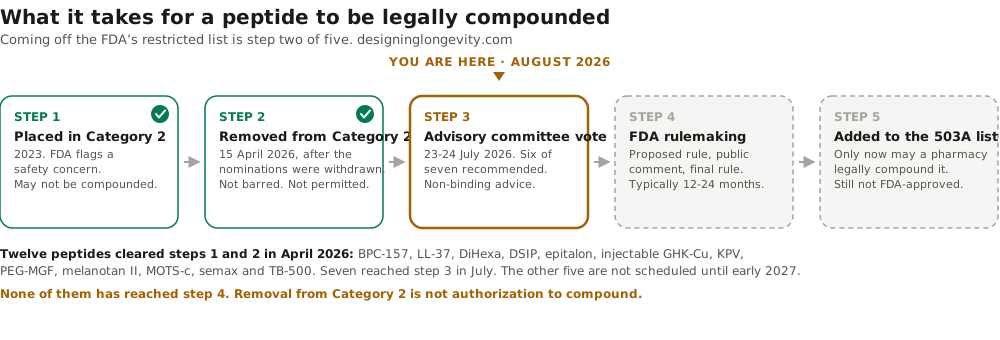
The reality: Everyone knows humans are using them, and the rules keep moving. In 2023 the FDA placed around twenty peptides in Category 2 of its 503A list, which effectively blocked compounding pharmacies from making them. It has since removed most of them from that category, including BPC-157 in April 2026, and in July 2026 an advisory committee voted to recommend six peptides for the permitted list. None of that is the same as approval. Until the FDA finishes formal rulemaking, these peptides sit in a gray zone: not explicitly prohibited, not authorized either.
“We've never faced a problem of, ‘What is it?’”
“I'm voting on something here, but I don't know what that something is. It's kind of like a black box to me.”
That is worth sitting with. The people whose job is to decide whether these compounds can be legally compounded said, on the record, that they could not always establish what the compounds are. If the regulator cannot pin down the identity of a substance, a vendor's certificate of analysis is not the reassurance it appears to be.
Thinking of buying compounded peptides anyway?
The FDA enforcement record on the biggest compounding pharmacies, and the six things worth checking before you order.
What this means for you: You're taking on the risk. No one is verifying purity. No one is liable if something goes wrong. Buy from reputable sources with third-party testing, and understand what you're getting into.
Practical Guides
Learn More
Frequently Asked Questions
What are peptides and why are they popular?
Peptides are short chains of amino acids, smaller than proteins but with similar biological activity. They're popular because they can trigger specific effects in the body like appetite suppression (GLP-1s), tissue healing (BPC-157), or skin rejuvenation (GHK-Cu). Some are FDA-approved medications, while others are sold as "research chemicals."
Are peptides legal to buy?
It depends on the peptide. FDA-approved peptides like semaglutide require a prescription. Non-FDA-approved peptides are typically sold as "research chemicals not for human consumption", this is a legal gray area. You can legally purchase them, but using them for human consumption technically violates their labeling.
Are peptides safe?
FDA-approved peptides have established safety profiles from clinical trials. Research peptides have limited human safety data, most evidence comes from animal studies. Key risks include: contamination from unregulated sources, unknown long-term effects, and unpredictable interactions when "stacking" multiple peptides.
What is the difference between FDA-approved peptides and research peptides?
FDA-approved peptides (like semaglutide/tirzepatide) have undergone rigorous human clinical trials proving safety and efficacy. Research peptides (like BPC-157, TB-500) have promising animal data but limited human trials. The quality control, purity standards, and legal protections differ dramatically between these categories.
How do I know if a peptide source is trustworthy?
Look for: third-party testing with Certificates of Analysis (COAs), established reputation in the community, transparent manufacturing information, and reasonable pricing (too cheap often means poor quality). Avoid sources making medical claims, as legitimate sellers market as "research purposes only."
Can I inject peptides at home?
Many peptides require subcutaneous injection. While some people do self-inject, this carries risks: improper reconstitution can degrade the peptide, contamination risks from improper technique, and no medical oversight for side effects. FDA-approved peptides from pharmacies come in pre-filled pens designed for home use.
I read that the FDA legalized 12 peptides in April 2026. Is that true?
No, and this is worth getting right because the claim is everywhere. On 15 April 2026 the FDA removed twelve peptides from Category 2 of its 503A list, the category reserved for substances it has flagged with identified safety risks. That removed a prohibition designation. It did not grant permission. The substances returned to an unapproved, unscheduled baseline: not explicitly barred, not authorized either, and still not on the 503A list of bulk substances compounding pharmacies may legally use. Two details make the "legalized" framing worse. First, they came off the list because the nominations were withdrawn and HHS directed it, not because the FDA reviewed the evidence and concluded they were safe. Second, none of them is an FDA-approved drug, so "prescribed legally" was never the situation being restored. If the FDA completes rulemaking to add some of them to the 503A list, that will be a genuine change, and it has not happened.
Which peptides can US compounding pharmacies legally make?
This is in active flux, and it is the single most misreported thing in this category. In 2023 the FDA placed around twenty peptides in Category 2 of its 503A list, flagging safety concerns and effectively blocking them from compounding. It removed five in September 2024 (AOD-9604, CJC-1295, ipamorelin, thymosin alpha-1, selank). Then on 15 April 2026, following withdrawal of the nominations and direction from HHS Secretary Robert F. Kennedy Jr., twelve more came off Category 2: BPC-157, LL-37, DiHexa, DSIP, epitalon, injectable GHK-Cu, KPV, PEG-MGF, melanotan II, MOTS-c, semax, and TB-500. Here is the part that gets reported wrongly: coming off Category 2 is not permission. It removed an explicit prohibition designation and returned these substances to an unapproved, unscheduled baseline. It did not put them on the 503A list of substances pharmacies may use, and the nominations were withdrawn rather than the FDA reassessing the safety evidence. An advisory committee then recommended six of them (BPC-157, KPV, TB-500, MOTS-c, semax, epitalon) for that list on 23-24 July 2026 and voted against DSIP, but advisory votes are non-binding and the FDA has not completed the rulemaking that would actually change the law. The other five, including LL-37 and injectable GHK-Cu, are not scheduled for review until before the end of February 2027. FDA-approved peptides like semaglutide, tirzepatide, tesamorelin, and PT-141 are unaffected and remain available by prescription.
Have a specific goal in mind?
Peptides are tools for specific outcomes. Start with what you want to achieve, then see which options might help.
Browse by Goal